Permits Needed for a Home Addition in Hudson Valley: What Every Homeowner Should Know Before Breaking Ground
Before starting a home addition, Hudson Valley homeowners must secure the right building permits from their local municipality. This guide covers which permits are required, why skipping them creates serious legal and financial risk, how the permitting process works, and what to expect in terms of cost and timelines. Working with an experienced local contractor simplifies the entire process.
You’ve finally made the decision to add space to your home. Maybe it’s a primary suite above the garage, a first-floor family room, or an in-law suite for aging parents. The plans are taking shape in your head, and you’re ready to move. Then someone mentions permits, and suddenly the excitement stalls. For many Hudson Valley homeowners, the permitting process feels like the most confusing, intimidating part of the entire project. But it doesn’t have to be. Once you understand exactly which permits are needed for a home addition and why they exist, the process becomes far less overwhelming.
Key Takeaways
- Nearly all structural home additions in New York State require at least one building permit, and often several.
- Skipping permits can result in fines, forced demolition, and serious complications when selling your home.
- The permitting process in Hudson Valley varies by municipality, so local knowledge matters.
- Permit costs typically depend on the square footage and scope of the project.
- A licensed design-build contractor will handle permit applications on your behalf in most cases.
- Starting the permitting process early is critical since approvals can take weeks to months.
Why Permits Exist and Why They Actually Protect You
Building permits aren’t bureaucratic red tape designed to slow you down. They exist because a home addition affects structural integrity, electrical loads, plumbing systems, and sometimes even neighborhood zoning. When a municipal building inspector reviews and approves your plans, they’re confirming that the work meets the New York State Building Code and local requirements. That review protects your family’s safety and the long-term value of your home.
Think about what it means when you sell your home five or ten years from now. A buyer’s attorney will pull the permit history on your property. Any unpermitted addition will surface during that search, and it can derail a sale entirely. Buyers either walk away or demand a significant price reduction. Lenders may refuse to finance a home with unpermitted square footage. The short-term convenience of skipping a permit almost always becomes a long-term headache.
Unpermitted work can reduce a home’s resale value by as much as 10 to 15 percent, and in some cases, municipal authorities can require full removal of the unpermitted structure at the homeowner’s expense. In New York, local code enforcement offices have the authority to issue stop-work orders and levy daily fines until violations are resolved.
What Types of Work Actually Require a Permit?
Not every improvement to your home triggers a permit requirement, but a home addition almost always does. The scope and combination of trades involved determine which permits get pulled. Understanding this from the start helps you ask better questions when talking to contractors.
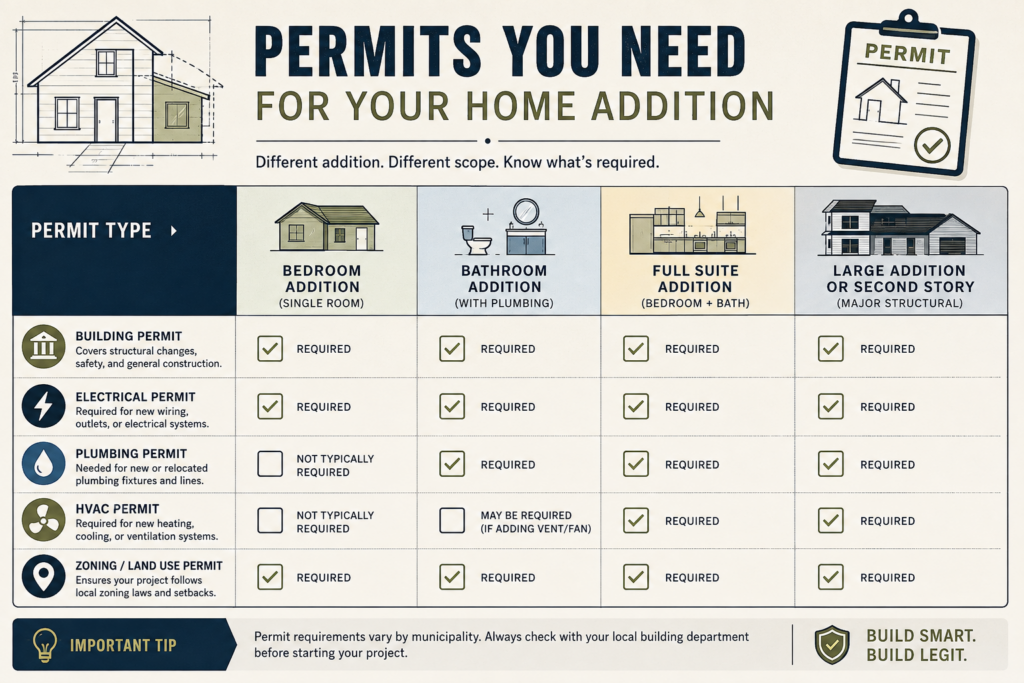
Here’s a breakdown of the permits most commonly needed for a home addition:
- Building Permit: Required for any new structural construction, including foundations, framing, walls, and roofing. This is the primary permit for any addition.
- Electrical Permit: Required when the addition includes new circuits, panel upgrades, or any wiring work performed by a licensed electrician.
- Plumbing Permit: Required if your addition includes a bathroom, laundry room, wet bar, or kitchen. New drain lines and water supply work all trigger this permit.
- HVAC Permit: Required when extending or adding new heating and cooling systems, ductwork, or mechanical equipment to serve the new space.
- Zoning Approval: Not technically a permit, but required before building permits are issued. Your addition must comply with setbacks, lot coverage limits, and height restrictions specific to your zoning district.
- Septic or Sewer Review: If your addition adds bedrooms or bathrooms, your existing septic system may need to be evaluated for capacity in areas of Hudson Valley not connected to municipal sewer.
How Does the Permitting Process Work in Hudson Valley?
Hudson Valley spans multiple counties including Dutchess, Ulster, Orange, Rockland, Putnam, and Westchester, and each municipality within those counties administers its own building department. That means the process, fees, and timelines in Rhinebeck look different from those in Newburgh or Goshen. Local familiarity is genuinely important here.
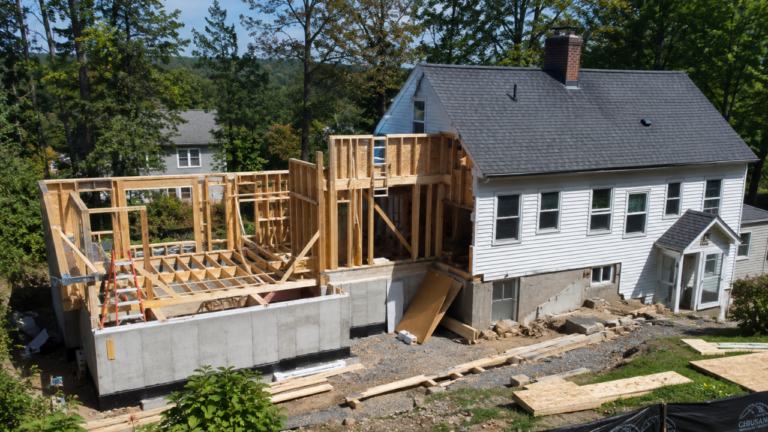
The general process follows a predictable sequence regardless of which town or village you’re in. Your contractor or architect submits a permit application along with stamped construction drawings to the local building department. A plan examiner reviews the documents for code compliance. Once approved, the permit is issued and work can begin. Throughout construction, the building inspector makes scheduled visits to verify that framing, electrical, plumbing, and insulation meet code before those systems are covered up. At the end of the project, a final inspection is completed and a Certificate of Occupancy is issued.
In many Hudson Valley municipalities, permit review timelines for residential additions range from two to eight weeks for standard projects. Larger or more complex additions, or those requiring variances from zoning boards, can take three to six months from application to approval. Scheduling buffer time for permitting is essential when planning your project start date.
If you want a complete picture of the planning process before permits even come into play, the guide on how to plan a home addition walks through the full sequence from concept to construction in plain language.
What Does a Home Addition Permit Actually Cost?
In New York, building permit fees for home additions are typically calculated as a percentage of the total project value or on a per-square-foot basis depending on the municipality. For a mid-sized addition, homeowners in Hudson Valley can generally expect permit fees ranging from $500 to $3,000 or more when accounting for building, electrical, plumbing, and HVAC permits combined. Zoning variance applications, when required, often add another $200 to $1,000 in fees plus potential legal review costs.
These costs are a small fraction of the total addition budget, and they’re non-negotiable. A permit fee is not something a reputable contractor will help you avoid. Any contractor suggesting you skip the permit process to save money is a serious red flag worth walking away from.
Who Handles the Permit Application?
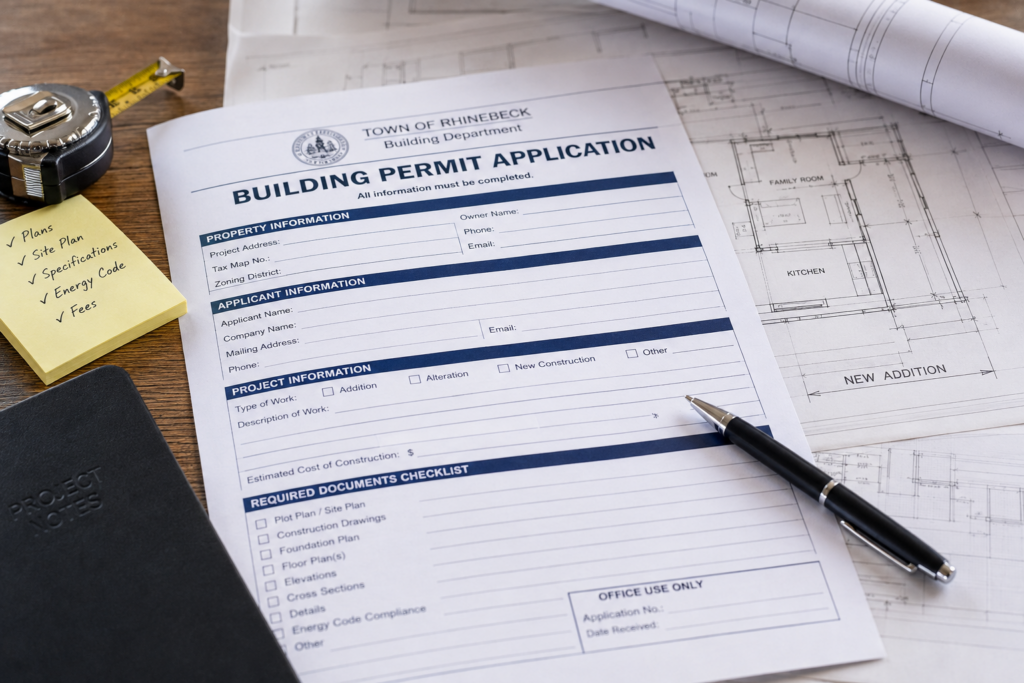
This is one of the most common questions homeowners ask. In New York State, either the homeowner or a licensed contractor can apply for a building permit. In practice, most reputable contractors handle the permitting process on your behalf as part of their service. This makes sense because the contractor is responsible for ensuring the work meets code, so they have a direct stake in submitting accurate and complete documentation.
When you work with an experienced local firm for your home addition services, permit management is typically folded into the project coordination process. Your contractor knows the local building department, understands which inspectors prefer what documentation formats, and can flag potential code conflicts before they become costly surprises during construction.
New York State requires that contractors performing electrical work hold a master electrician license, and plumbing work must be performed by or under the direct supervision of a licensed master plumber. Both trades must pull their own permits in most jurisdictions. A general contractor coordinating your addition will subcontract these trades and ensure the appropriate licensed professionals are pulling their own permits as required by law.
If you’re still exploring what kind of addition would work best for your property, browsing through home addition ideas specific to Hudson Valley homes can help you think through scope before the permitting conversation even begins.
What Happens If You Build Without a Permit?
Some homeowners assume that if they’re not planning to sell for twenty years, unpermitted work won’t matter. That assumption is risky on multiple levels. Neighbors can report unpermitted construction. Insurers can deny claims for damage that occurs in unpermitted areas of a home. And when you eventually do sell, the problem surfaces regardless of how much time has passed.
Retroactively permitting an addition is possible, but it’s often more expensive and disruptive than doing it right the first time. Inspectors may require sections of finished walls or ceilings to be opened up so they can verify what’s behind them. In some cases, work that didn’t meet code at the time it was done must be brought into compliance before a retroactive permit can be issued. The cost and disruption of going back often dwarfs whatever was “saved” by skipping the permit originally.
Thinking through creative home addition ideas early in the process, before any work begins, gives you the space to plan correctly from the start, permits included.
Frequently Asked Questions
Do I need a permit for a home addition?
Yes, in virtually all cases. Any home addition that involves new structural construction, changes to your electrical system, new plumbing, or HVAC work will require one or more permits from your local building department. Even a simple room addition that looks straightforward on paper typically triggers at minimum a building permit and an electrical permit. Check with your local municipality for the specific requirements in your area.
What types of home additions require a permit?
Any addition that is attached to your home and involves structural framing, a foundation, or connections to your home’s mechanical systems requires permits. This includes bedroom additions, bathroom additions, family room expansions, second-story additions, garage conversions, and in-law suites. Detached structures like sheds or workshops may have different permit thresholds depending on size and your municipality’s rules.
Can I build an addition without a permit?
Technically it’s possible, but doing so creates serious legal, financial, and safety risks. Unpermitted work can result in stop-work orders, fines, and mandatory removal. It complicates home sales, can void homeowner’s insurance coverage for related damages, and may require expensive retroactive permitting later. No reputable contractor will recommend or agree to build an addition without proper permits in place.
Who is responsible for getting the permit, the homeowner or the contractor?
Either party can apply for a building permit in New York State, but in practice, most licensed contractors handle this as part of their project management process. Licensed subcontractors such as electricians and plumbers are typically required to pull their own trade-specific permits. Your general contractor should be able to walk you through exactly who will be pulling which permits before construction begins.
How much does a home addition permit cost?
Permit fees in Hudson Valley vary by municipality and project scope, but most homeowners should budget between $500 and $3,000 or more for the full suite of permits on a mid-sized addition when accounting for building, electrical, plumbing, and HVAC permits. Projects requiring zoning variances or environmental reviews will incur additional fees. Your contractor can provide a realistic estimate of permit costs for your specific project and location.
Ready to Move Forward? Here’s Your Next Step
The permitting process is not the obstacle it might seem at first. With the right contractor guiding the process, permits are handled efficiently as part of a well-managed project, not as a last-minute scramble. The real risk is not having permits. The cost of getting them right is minor compared to the legal, financial, and practical consequences of building without them.
If you’re planning a home addition in Hudson Valley and want to work with a team that knows the local building departments, understands the regional permitting landscape, and manages the entire process from design through Certificate of Occupancy, Chiusano Design Build is ready to help. Whether you’re in Poughkeepsie, Newburgh, Kingston, or anywhere across the region, their team brings the local expertise that makes a meaningful difference on complex projects.
Call Chiusano Design Build at 845-201-9450 to schedule a consultation, or Contact Us online to start the conversation. Your addition starts with the right foundation, and that includes getting the permits handled correctly from day one.