How to Finance a Home Addition in Hudson Valley (Without the Guesswork)
Financing a home addition in Hudson Valley doesn’t have to be overwhelming. This guide breaks down the most practical funding options available to homeowners, from home equity loans and HELOCs to construction loans and personal financing, so you can choose the right path before the first shovel hits the ground.
You need more space. Maybe it’s a growing family, a parent moving in, or a home office that’s outgrown the corner of your bedroom. You know what you want to build. What you’re not sure about is how to pay for it without draining your savings or making a financial decision you’ll regret five years from now. That uncertainty is exactly what this guide is designed to clear up.
Key Takeaways
- Home equity loans and HELOCs are the most popular financing tools for home additions because they use your existing equity and typically carry lower interest rates than personal loans.
- Construction loans are worth considering for larger, phased projects where funds are drawn in stages rather than all at once.
- Most lenders require at least 15 to 20 percent equity in your home before approving a home equity product.
- Your credit score, debt-to-income ratio, and project scope all directly affect which financing options you qualify for.
- The right financing option depends on your timeline, total project cost, and how much equity you’ve built up.
- Planning your financing before you plan your floor plan will save you from costly surprises mid-project.
Why Financing Feels So Complicated (And Why It Doesn’t Have to Be)
Most homeowners don’t buy a home addition the way they buy a car or a kitchen appliance. There’s no simple sticker price, no monthly payment calculator sitting on a website, and no salesperson walking you through a showroom. The cost is real, the commitment is significant, and the financing landscape has more options than most people realize.
Hudson Valley homeowners face a specific set of circumstances that make this decision worth thinking through carefully. Property values across the region have climbed steadily over the past several years, which means many homeowners are sitting on more equity than they recognize. That equity is often the most powerful financial tool available when it comes to funding a major renovation or addition.
Before you start comparing lenders or loan types, it helps to get a realistic sense of what your project will cost. Exploring the types of home additions that make sense for your property and your budget gives you a concrete number to work toward, which makes every financing conversation much more productive.
What Are the Most Common Ways to Finance a Home Addition?
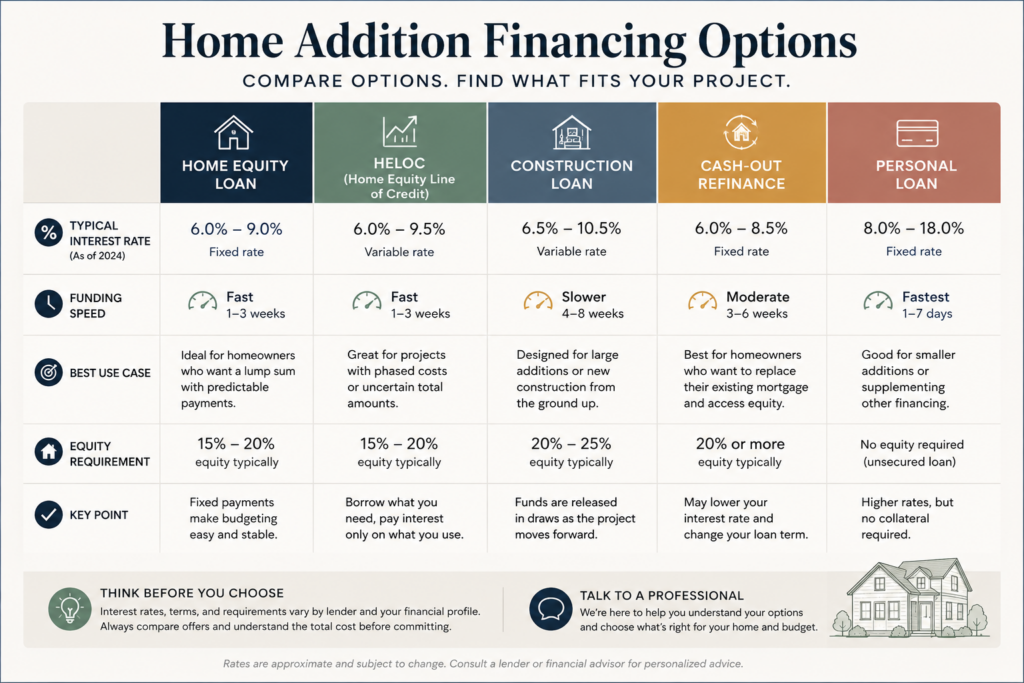
There’s no single correct answer, and any contractor or lender who tells you otherwise isn’t giving you the full picture. The right financing method depends on how much your addition will cost, how much equity you have, your credit profile, and how quickly you want to move. That said, most Hudson Valley homeowners end up choosing from a handful of well-established options.
Home Equity Loans
A home equity loan lets you borrow a lump sum against the equity you’ve built in your home, repaid at a fixed interest rate over a set term. Because the loan is secured by your property, rates are generally lower than unsecured personal loans. You know exactly what you’re borrowing, what your monthly payment will be, and when the loan ends. For homeowners with a well-defined project scope and a firm budget, this predictability is genuinely useful.
Home Equity Lines of Credit (HELOCs)
A HELOC works more like a credit card secured by your home. You’re approved for a maximum credit line, and you draw from it as needed during a set draw period. This structure works well for projects that unfold in phases or when final costs are harder to pin down upfront. The tradeoff is that HELOCs typically carry variable interest rates, which means your monthly costs can shift over time as market rates change.
Construction Loans
A construction loan is a short-term loan that funds your project in draws tied to construction milestones rather than releasing the full amount upfront. Once construction is complete, it’s typically converted into a conventional mortgage or paid off through refinancing. These loans carry a bit more complexity and require lender oversight of the project, but they can be a smart fit for larger additions where managing cash flow matters.
Cash-Out Refinancing
If your current mortgage rate is higher than today’s rates, or if you have significant equity built up, a cash-out refinance lets you replace your existing mortgage with a larger one and pocket the difference. The funds can be used for any purpose, including your home addition. This option resets your mortgage term and changes your monthly payment, so it deserves careful modeling before you commit.
Personal Loans and Contractor Financing
For smaller additions or homeowners who don’t yet have substantial equity, personal loans and contractor-arranged financing programs offer a path forward without tapping into home value. Interest rates are typically higher, and loan amounts may be capped at levels that won’t cover a full addition, but for targeted projects like a bathroom addition or sunroom, they can work.

How Do Home Equity Loans and HELOCs Actually Work for This?
Home equity products are consistently the most commonly used financing vehicle for major home improvement projects. According to industry data, home equity loans and HELOCs together account for a significant share of renovation financing, particularly for projects exceeding $50,000. The appeal is straightforward: interest rates on these products are substantially lower than unsecured personal loans or credit cards because the lender’s risk is backed by your property.
The process starts with your lender ordering a home appraisal to determine current market value. From there, they calculate how much equity you have and how much of it they’re willing to lend. Most lenders will allow you to borrow up to 80 or 85 percent of your home’s appraised value, minus what you still owe on your mortgage. The remaining figure is your available borrowing power.
In the Hudson Valley, where median home values have increased considerably over the past five years, many homeowners who purchased before 2020 are sitting on equity they haven’t fully accounted for. A home purchased at $350,000 that has appreciated to $480,000, with a remaining mortgage balance of $250,000, could potentially support a home equity line of well over $100,000 depending on the lender’s specific loan-to-value limits.
Before assuming a HELOC is the right choice over a home equity loan, think about how your project will actually be managed. If your contractor bills in phases and you won’t need the full amount immediately, a HELOC’s flexible draw structure may save you money on interest. If you’re working with a fixed contract and a defined budget, the predictability of a lump-sum home equity loan at a locked rate often wins out.
Is a Construction Loan Worth the Extra Effort?
Construction loans typically carry interest rates slightly higher than conventional mortgages or home equity products, and they require the borrower to pay interest only on funds drawn during the construction phase. Once the project is complete and the loan converts to a permanent mortgage, the full principal and interest repayment begins. This structure can keep monthly costs manageable during a build that spans six to twelve months.
For most homeowners adding a bedroom, a bathroom, or a modest square footage bump, a construction loan may be more complexity than the project warrants. But if you’re planning a substantial addition, such as a full second story, an in-law suite, or a major structural expansion, the draw-based structure can be genuinely valuable. It keeps large sums of money from sitting idle in an account while framing is still underway.
One practical consideration: construction loans typically require your lender to review and approve the project plans before funds are released. That means having a complete design and a detailed contractor scope of work ready before you apply. Understanding the home addition construction timeline before you approach a lender helps you set realistic expectations on both sides of the conversation.
What Does Your Credit and Equity Profile Need to Look Like?
Most lenders require a minimum credit score of 620 to qualify for a home equity loan or HELOC, though borrowers with scores of 700 or higher will typically access better rates and more favorable terms. A debt-to-income ratio below 43 percent is a common threshold, though individual lender standards vary. On the equity side, most institutions want you to retain at least 15 to 20 percent equity in your home after the loan is issued, which limits how much you can borrow against properties with modest appreciation or recent purchase.
If your credit score isn’t where you’d like it to be, it’s worth spending a few months improving it before applying. Even a modest improvement of 20 to 30 points can shift you into a better rate tier and meaningfully reduce what you pay over the life of a loan. Paying down revolving balances, disputing any errors on your credit report, and avoiding new credit inquiries in the months before you apply are all moves that can help.

What Else Should You Think Through Before Choosing a Financing Path?
The cheapest interest rate isn’t always the most important variable. How quickly do you need to move? Some financing options take weeks to finalize. If permits are already in hand and your contractor is ready to start, a loan product that takes two months to close could delay your entire project. Knowing your home addition permit requirements in advance helps you sequence the financing and approval process so they don’t work against each other.
Also consider the total cost of borrowing, not just the monthly payment. A longer loan term lowers your monthly payment but increases the total interest you pay. Run the full numbers on a few scenarios before you sign anything. Your financial advisor or mortgage broker can help, but having a rough sense of total cost before that conversation makes you a much more informed decision-maker.
Home additions consistently rank among the highest-ROI home improvement projects in terms of property value return. Depending on the addition type and regional market, homeowners may recoup 50 to 80 percent or more of their project cost in added home value, with certain addition types such as primary suite additions or garage additions with living space performing particularly well in competitive housing markets like the Hudson Valley.
Think about your exit strategy too. Are you planning to sell within three to five years, or is this your home for the next decade? If you’re planning to stay long-term, a home equity loan with a 10 or 15-year payoff works well. If you might sell sooner, a HELOC you can pay off at closing often gives you more flexibility.
Frequently Asked Questions About Financing a Home Addition
What are the most common ways to finance a home addition?
The most widely used options are home equity loans, HELOCs, construction loans, cash-out refinancing, and personal loans. Home equity products tend to be the most cost-effective for homeowners with meaningful equity built up, because they use your home as collateral to secure a lower interest rate. Personal loans and contractor financing programs can work for smaller projects or homeowners who haven’t yet built enough equity to qualify for a home equity product.
Can I use a home equity loan or HELOC for a home addition?
Yes, and many Hudson Valley homeowners do exactly that. Both products let you borrow against your home’s current market value minus what you owe on your mortgage. A home equity loan delivers a fixed lump sum at a fixed rate, while a HELOC gives you a revolving credit line you can draw from as needed. Which one fits better depends on your project scope, budget certainty, and preference for fixed versus variable payments.
Is a construction loan a good option for financing a home addition?
It can be, particularly for large or complex additions where costs are drawn in phases over an extended build period. Construction loans release funds in draws tied to project milestones, which can reduce the interest you pay by keeping unused funds out of your balance. The tradeoff is more paperwork, lender oversight of the project, and a more involved application process. For straightforward additions with a fixed contract, a home equity loan or HELOC is often simpler.
How much equity do I need to finance a home addition?
Most lenders want you to retain 15 to 20 percent equity in your home after the loan is issued. In practical terms, this means you need to have enough appreciation and mortgage paydown to support that floor while still having meaningful borrowing power left over. If your home has risen in value since you purchased it, you may have more available equity than you realize. Getting a current appraisal is the most reliable first step.
What should I consider before choosing a financing option for my home addition?
Start with your total project cost, your credit profile, and how much equity you’ve built. From there, factor in your timeline, since some loan products take longer to close than others. Consider whether you want fixed or variable payments, how long you plan to stay in the home, and what your total cost of borrowing looks like over the life of the loan, not just month to month. Talking through your project with a design-build firm before approaching lenders can also give you a more accurate budget to work from, which makes every financing conversation much easier.
Ready to Build? Start With a Plan You Can Actually Fund
The homeowners who get through a home addition without financial stress aren’t the ones who spent the most money. They’re the ones who locked in their financing strategy before they broke ground, worked with a team that gave them honest numbers upfront, and built a project scope that matched their budget from day one.
If you’re thinking about adding space to your home in the Hudson Valley and you want guidance from people who’ve been through this process hundreds of times, Chiusano Design Build is a good place to start. From scoping your project realistically to helping you understand what your dollar will accomplish, the team works alongside you before a single permit is pulled. You can explore the full range of home addition services offered, or start your home addition with a conversation about what’s possible for your property and your budget.
Call 845-201-9450 to speak with the Chiusano Design Build team directly. No pressure, no guesswork, just a clear-eyed conversation about what your project will take and what it will cost.